Why AI Detection Tools Are Failing
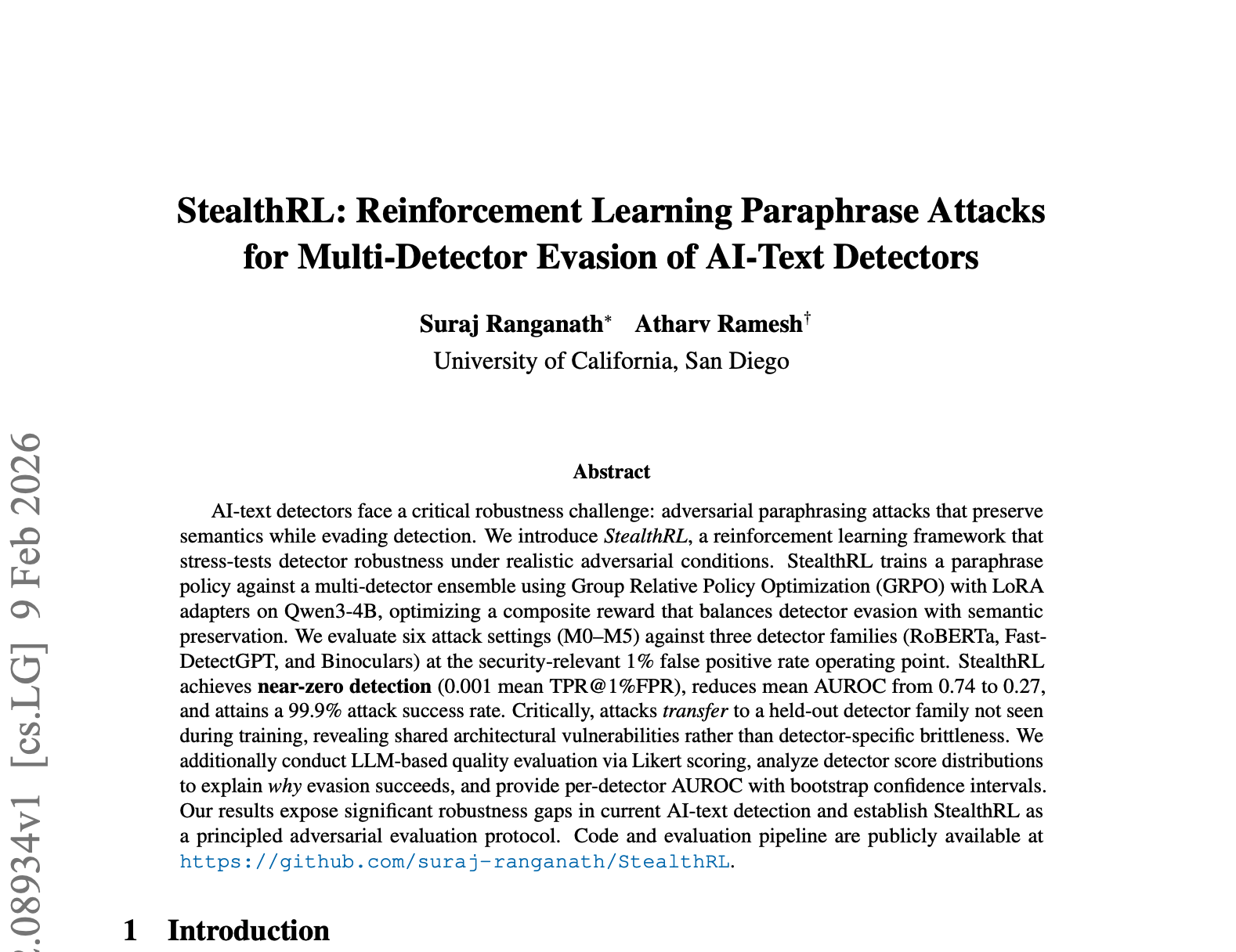
A new research paper released this month introduces StealthRL, and it might just be the superbug of AI-generated text.
For the last year, universities, journals, and regulatory bodies have relied on AI detection tools to flag content written by machines. These tools look for specific statistical fingerprints left behind by models like ChatGPT.
StealthRL changes the game.
Researchers successfully used Reinforcement Learning (a training method based on rewards and penalties) to create an AI agent with one specific goal: mutate the text just enough to evade detection while keeping the meaning exactly the same.
Detection software like RoBERTa or Binoculars can no longer recognize it. In tests, StealthRL bypassed major detectors with a near 100% success rate.
Why Does This Matter for Life Sciences?
You might be thinking, "I don't grade essays, so why should I care?"
In the life sciences, trust is our currency. If AI can invisibly mimic human writing, we face significant challenges in:
Scientific Integrity. How do we verify that the "Novel Hypothesis" section of a grant or the discussion in a peer-reviewed paper represents human critical thinking and not a hallucination that slipped past the filters?
Regulatory Compliance. When submitting clinical trial summaries or safety reports to bodies like the FDA, assurance of authorship and accountability is legal, not just ethical.
Data Security. Stealth text can be used for sophisticated phishing attacks that mimic the writing style of colleagues or executives to gain access to sensitive patient data or IP.
It’s Time to Move from Detection to Provenance
The lesson from StealthRL is clear: We cannot rely on detection tools anymore. The mimics are getting too good.
Instead, the industry is moving toward provenance, cryptographic or other forms of watermarking that proves where a document came from. Just as we require a chain of custody for a biological sample, we will soon need a digital chain of custody for our data and reports.
The AI is evolving and our protocols need to evolve with it.
